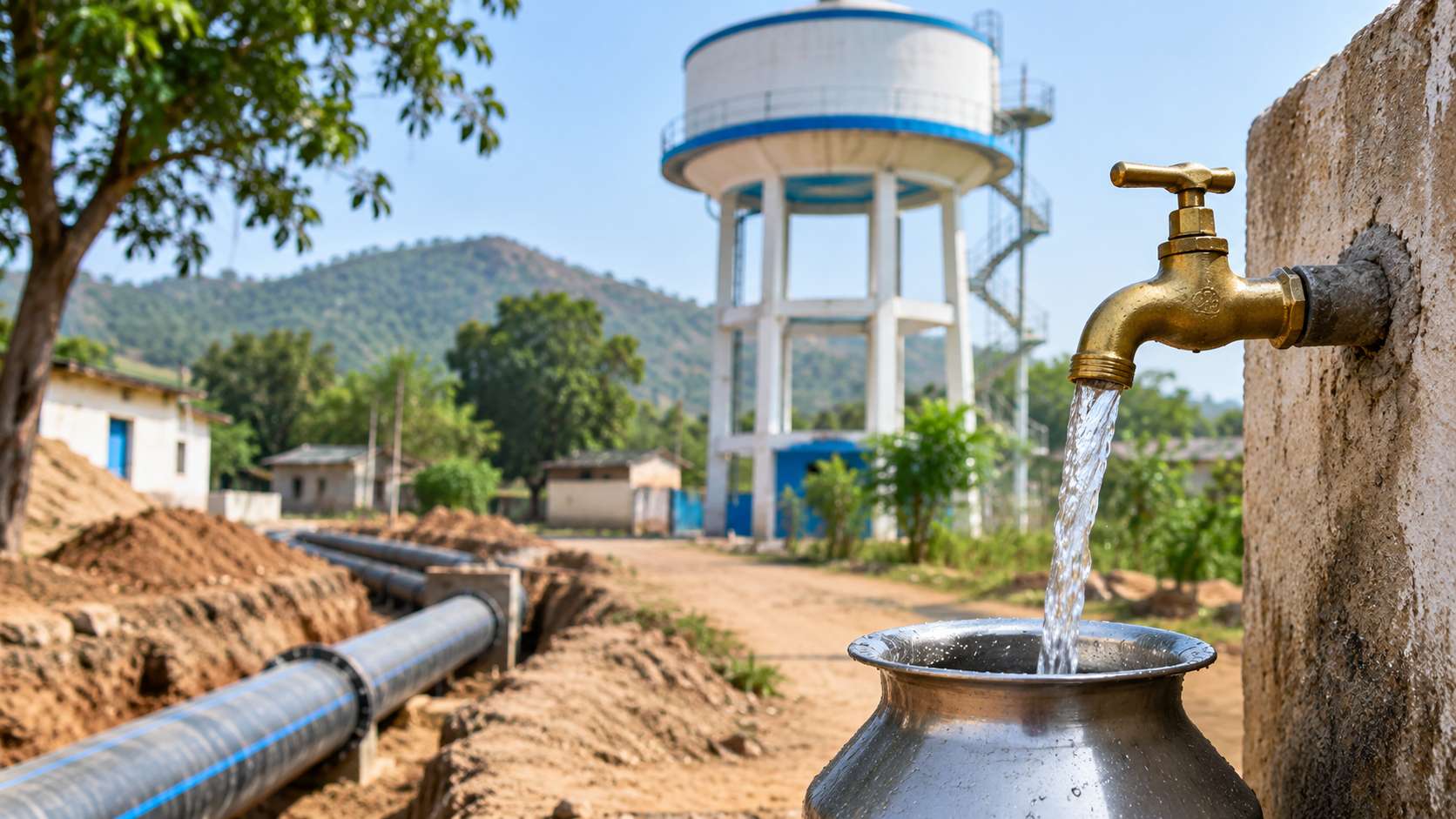
Dungarpur/Jaipur: A drinking water supply scheme aimed at providing tap water facilities to 353 villages in Dungarpur district is losing momentum, with land-related hurdles, pending clearances at various levels and delays in payments affecting the pace of execution.
Being implemented for the Rajasthan Public Health Engineering Department (PHED), the project involves the construction of drinking water infrastructure, along with its operation and maintenance for 10 years. The scheme is scheduled to be completed between June 2025 and February 2027. However, the unavailability of land and delays in securing mandatory permissions have stalled several crucial works.
Land clearances remain pending even 14 months after work order
Land-related approvals have emerged as one of the biggest bottlenecks for the project. Even 14 months after the issuance of the work order, approvals have been secured only for select stretches of the pipeline and a limited number of proposed sites for overhead service reservoirs (OHSRs) and master balancing reservoirs (MBRs).
The non-availability of land has forced repeated changes in project locations. Moreover, discrepancies between the data provided at the tendering stage and the actual ground situation have necessitated fresh surveys, design modifications and resubmission of proposals.
A person associated with the project, speaking on condition of anonymity, said land-related objections were also emerging at the village level. This has made it difficult to secure land for the construction of boundary walls around water treatment plants (WTPs) and other water storage infrastructure. The project, estimated to cost around Rs 463 crore, is being executed by Afcons Infrastructure Ltd. Afcons spokesperson confirmed the delay in execution of the project but refused to comment further.
Design and drawing approvals also stuck
Clearances for project designs and drawings have also become a major impediment. Of the proposed 172.5-km transmission main pipeline, only a 27-km loop has so far been taken up for the approval process. Clearance for the remaining stretches is pending as sites for MBRs, clear water reservoirs (CWRs) and OHSRs are yet to be finalised.
Similarly, of the proposed 446.1-km gravity main pipeline, approval has been granted for only 45.7 km. Of this approved stretch, around 30 km of pipeline has already been laid.
Third-party inspection agency inactive, transfers add to delays
Administrative bottlenecks have further compounded the problem. The project's third-party inspection agency, WAPCOS, has reportedly remained inactive since December 2025.
Frequent transfers of PHED officials have also disrupted the approval process. The incumbent superintending engineer (SE) and additional chief engineer (Additional CE) are handling responsibilities for multiple districts, adding to the backlog in design approvals, inspections and work certification, said sources.
Crops, right-of-way issues hamper pipeline laying
Sources said the execution on the ground has also been affected by several local-level hurdles. Standing crops in agricultural fields have made it difficult to lay pipelines. Delays in securing right-of-way (RoW) permissions from highway authorities, coupled with opposition from local residents, have further slowed progress.
According to officials associated with the project, hydraulic design approvals for entire clusters are getting delayed even if a single OHSR location remains unresolved. Consequently, uncertainty over one location is affecting work across the entire cluster, slowing down the implementation of the drinking water scheme.